


Introduction
Wavelet Transform
Groundroll Suppression in Land-based Synthetic Data
Characteristic of Wavelet Domain for the Field Seismic Data
Conclusions
Introduction
Surface waves in land seismic reflection data are unwanted noise degrading continuities of reflections. Groundroll is a surface wave whose vertical component is composed of dispersive Rayleigh waves (Dobrin, 1951; Gadallah and Fisher, 2005). The waves travel at different velocities and lead to long complex wavetrains that change as traveling distance increases. Such noises contaminate near-offset events in the field records, subsequently resulting in low S/N prestack and poststack data (Al- Husseini et al., 1981; Beresford-Smith and Rango, 1988; Kim et al., 1994; Yilmaz, 2001).
Conventional schemes of removing the groundroll from the shot records include frequency filtering (Kim et al., 2014), windowed frequency filtering (Nawab and Quatieri, 1988), and f-k filtering (Hatton et al., 1986). A fundamental feature of the techniques is that they are based on Fourier transform (FT), which assumes that the signal is stationary and represents frequency distribution averaged over the entire time series (Bracewell, 1986; Claerbout, 1976). This might not be the appropriate basis for dealing with seismic signals because its frequency content varies with time. Thus an alternative approach to address the problem was introduced in the late 1990s, called wavelet transform (WT), to identify each frequency component at a specific time and remove frequencies regarding unwanted noises only (Chakraborty and Okaya, 1995; Mallat, 1989; Morlet et al., 1982). This technique decomposes the seismic traces into time-scale wavelet coefficients on wavelet domain, where the scales can be considered as a frequency range (Deighan and Watts, 1997; Miao and Moon, 1999).
Regarding the domestic studies on the WT technique for seismic reflection data, there has been quite a few papers since the 2000s. However, they are limited to the research into the selection of mother wavelet (Choi, 2000), data compression (Kim, 2001), and applications to the marine data (Kim et al., 2008a,b; Shin et al., 2008).
Land-based synthetic and field seismic data were chosen for this research to test their suitability in the application of WT decomposition for the rejection of the surface wave and the random noises. We provide a conceptual description of WT and show the application of wavelet filtering technique to eliminate the groundroll in land-based data, by comparing the results to the ones with bandpass filtering and f-k filtering in terms of the continuities and resolution of the reflections.
Wavelet Transform
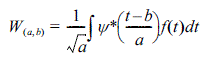
A continuous wavelet transform (CWT) analyzes frequencies using a convolution of the seismic trace f(t) with the basis function ψ(t) to transform the signal from the time domain to the wavelet domain (Goupillaud et al., 1985; Morlet et al., 1982),
 (1)
(1)
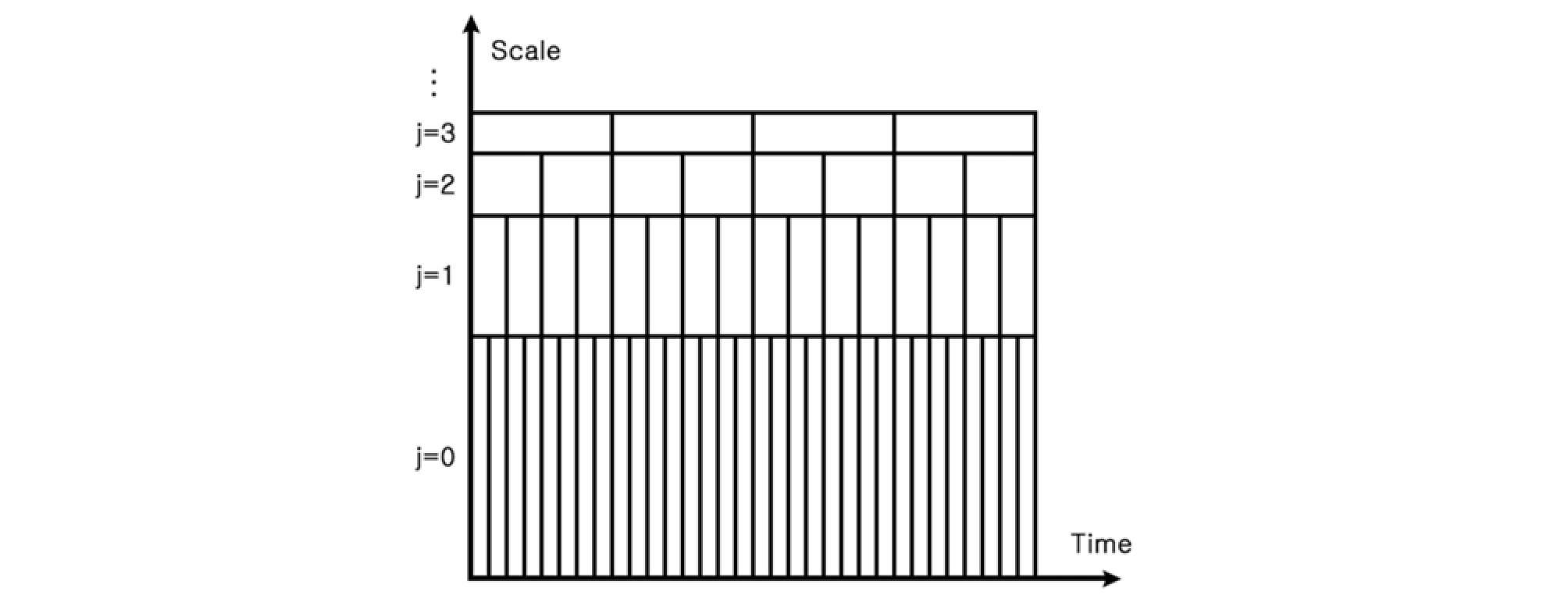
where the basis function ψ(t) is called the kernel wavelet and the parameters a and b are called scale and translation, respectively. At each scale(i.e., for each value of a) the kernel wavelet is scaled by a factor 1/a - in implementation, a is replaced by 2j, where j is the scale index- and translated by b to produce the wavelet coefficient W(a, b) corresponding to the frequency component at each time in time domain, then the values are represented in time-scale space on wavelet domain (Fig. 1). In this manner, low scales represent the basis function containing the high frequencies and high scales represent the opposite.
Because CWT has a problem that spends cost much to calculate the integration procedure (Eq. (1)), a complemented method using a fast algorithm is introduced, called discrete wavelet transform (DWT) (Daubechies, 1988; Mallat, 1989). During the forward transform, the seismic trace is filtered by a half-band low pass and a half-band high pass followed by a down sampling by a factor of two. The output of the high-pass filter is wavelet coefficients for the level (scale) in specific times, and the process is repeated on the output of the low-pass filter after down sampling until the desired level of decomposition is achieved. This procedure has equivalent effect of CWT where the scale index of the kernel wavelet changes by integral values.
Groundroll Suppression in Land-based Synthetic Data
The wavelet filtering technique was tested on a shot record from land-based synthetic data by the courtesy of WesternGeco-OMEGA software (Schlumberger Ltd, 2017). The seismic data were collected using shots and receivers placed at 25 m and 12.5 m spacing, respectively, and recorded at a 2 ms sample rate in record length of 3 s. The white noises are added for some traces assuming that land seismic data usually produce ringing noises due to either poor geophone coupling or some kind of ringing of the air in the shot depth. Coiflet-3 wavelet was selected in this study to minimize frequency overlap causing aliased noise between scales and satisfy a wavelet shape to be symmetrical with exponential time decay in terms of nonstationary property (Fig. 2) (Deighan and Watts, 1997). A typical shot record is contaminated by groundroll, which degrades continuities of most reflection events over the entire time (Fig. 3a).
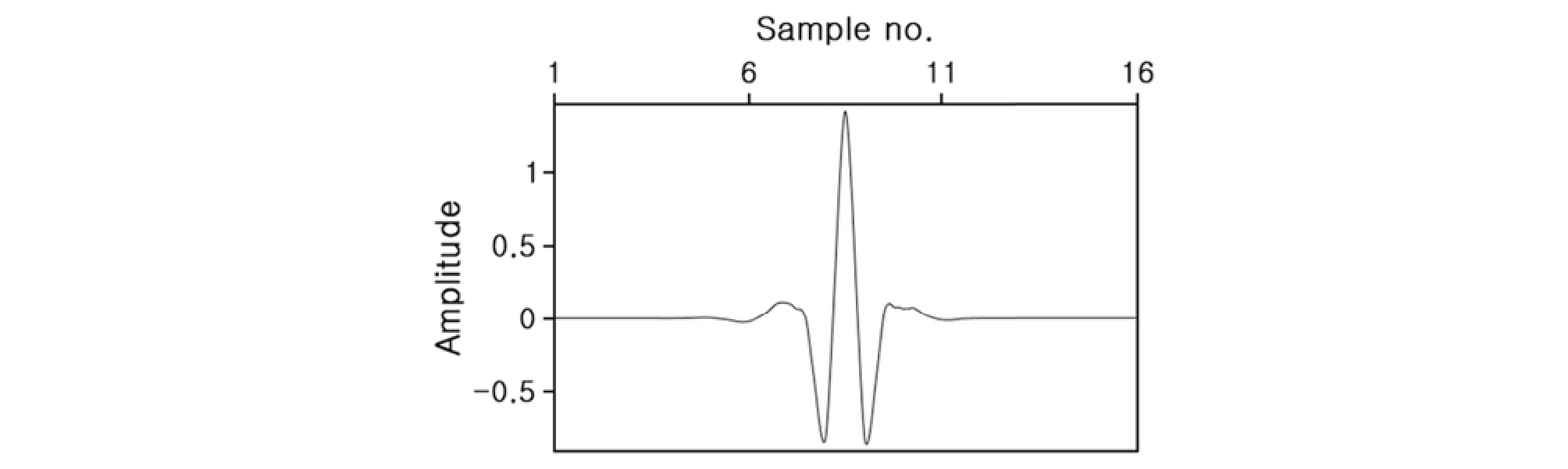
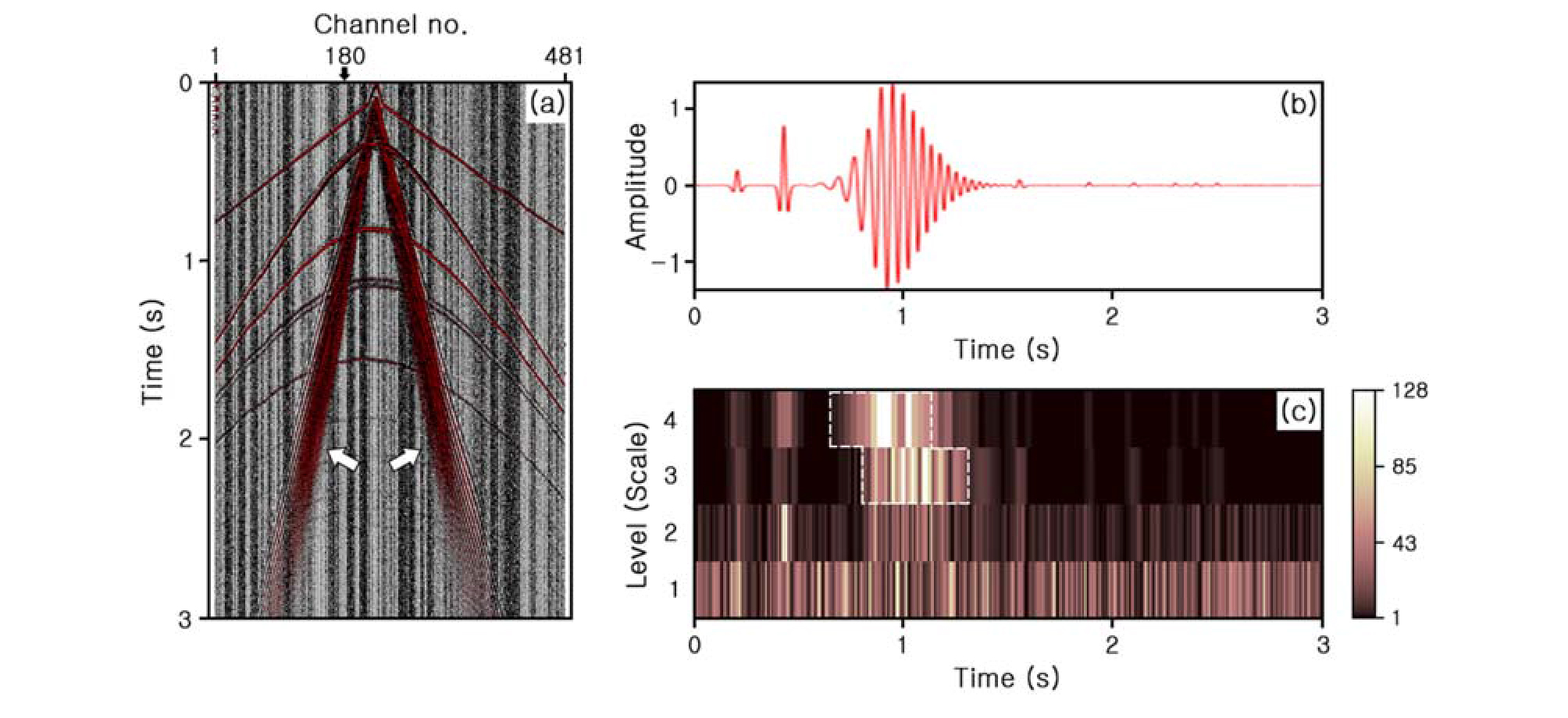
Fig. 3.
(a) Land-based synthetic shot record (by the courtesy of WesternGeco) is contaminated by groundroll over the entire time (white arrows), degrading the continuities of reflection events. (b) Groundroll appearing at approximately 700~1300 ms for the trace 180 corresponds to (c) the white dotted area at scales 3 and 4 on time-scale decomposition.
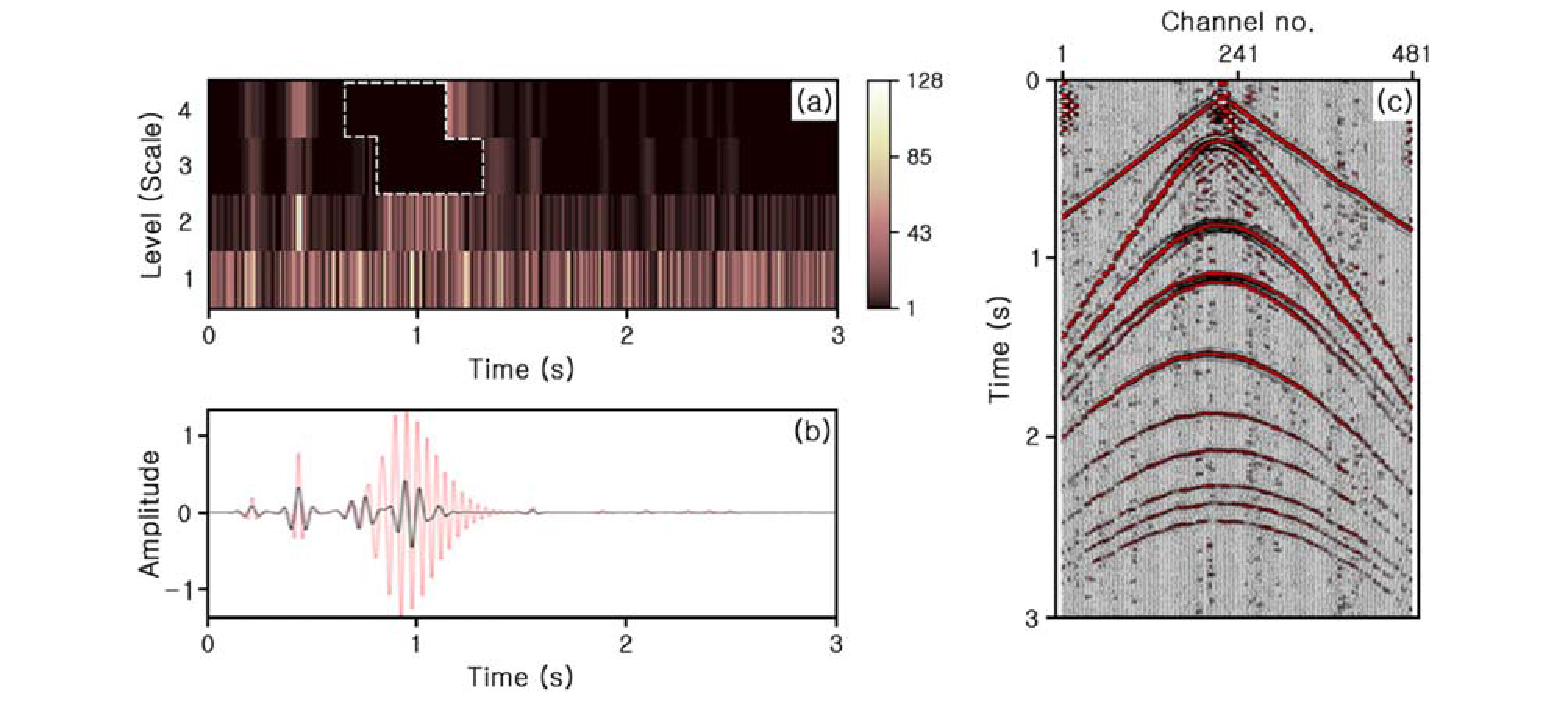
The WT operations were applied on a trace-by-trace basis, and the time-scale representation of the trace 180 (Fig. 3b) is shown in Fig. 3c. The groundroll at approximately 700~1300ms in time domain is characterized by peak amplitudes and low frequencies and its energy is mainly concentrated at 750~1250 ms of the scales 3 and 4. With zeroing wavelet coefficients for the groundroll in the time-scale areas (Fig. 4a), the noises are effectively suppressed after WT filtering (Fig. 4b). Trace-by-trace filtering of the shot record shows overall improvement of most reflection events (Fig. 4c). Reflection hyperbolas are more distinctly shown with groundroll and random noises almost completely suppressed.
The shot record after the wavelet filtering was compared to the bandpass and f-k filtered records in Fig. 5. In the filtered records, the groundroll is suppressed almost completely. But considerable reflections were also removed in the bandpass filtered record (Fig. 5b) because high-pass filter bandwidth (>40 Hz) for attenuating the low frequencies of the groundroll inevitably cuts some of the reflection events. And the f-k filtered record with removing the velocity slopes (<770 m/s) regarding the groundroll was boosted with random noises (i.e., ringing) (Fig. 5c). Because the weak reflections coincidently exist with the low-frequency noises, they appeared down to about 2.3 s (at zero offset) once large-amplitude noises are peeled off. Because the wavelet coefficients for groundroll energy are only zeroed in specific time interval, reflection hyperbolas are distinctly shown deeper down to about 2.6 s with groundroll and random noises more clearly rejected (Fig. 5d).
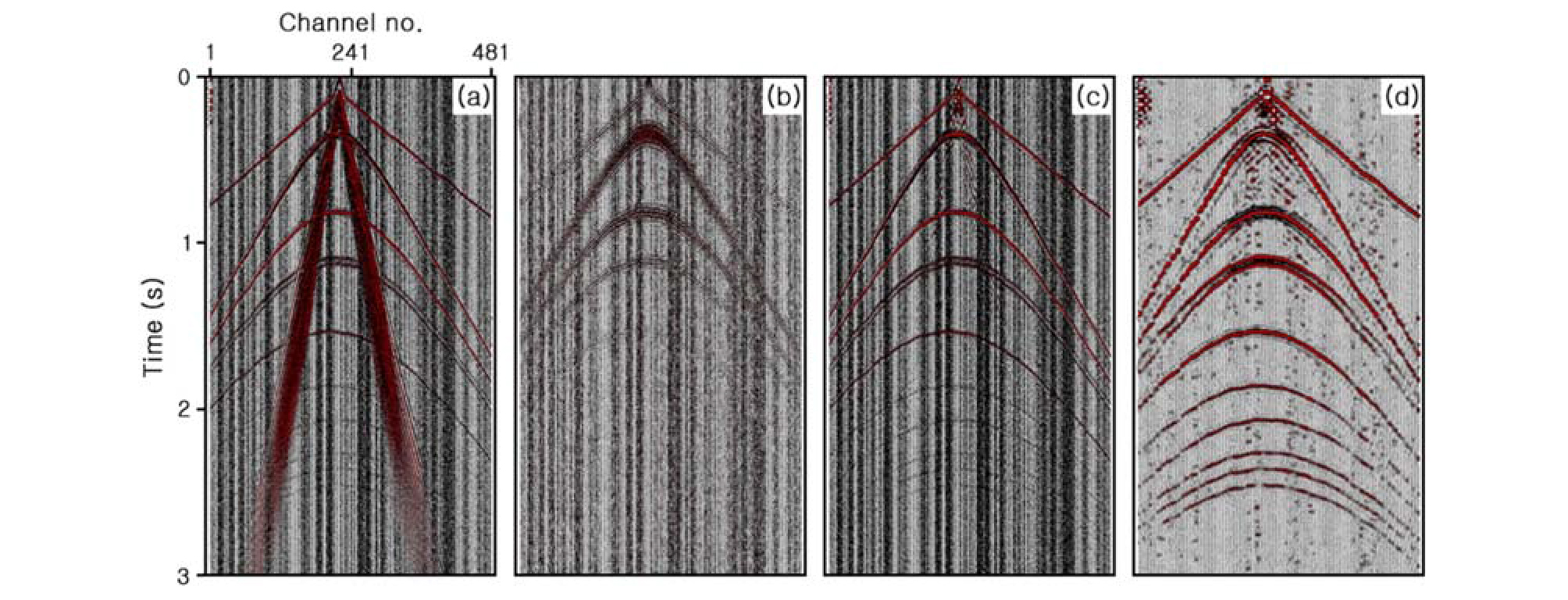
Fig. 5.
Comparison of filtering effects for groundroll rejection with (a) no filtering (by the courtesy of WesternGeco), (b) bandpass, (c) f-k, and (d) WT filters. Reflections with WT filters are distinctly shown deeper down to approximately 2.6 s (at zero-offset) with groundroll and ringing noises almost rejected.
Characteristic of Wavelet Domain for the Field Seismic Data
Based on the investigation of synthetic data, wavelet domain for the field seismic data was investigated on a shot record from Blackfoot field in Alberta, Canada (Gallant et al., 1995). The data were collected using 6 kg dynamite sources, 10 Hz geophones with 20 m spacing, sampling rate of 2 ms, and record length of 5 s. A sample shot record (Fig. 6a) shows near-offset reflection hyperbolas heavily contaminated by the groundroll.
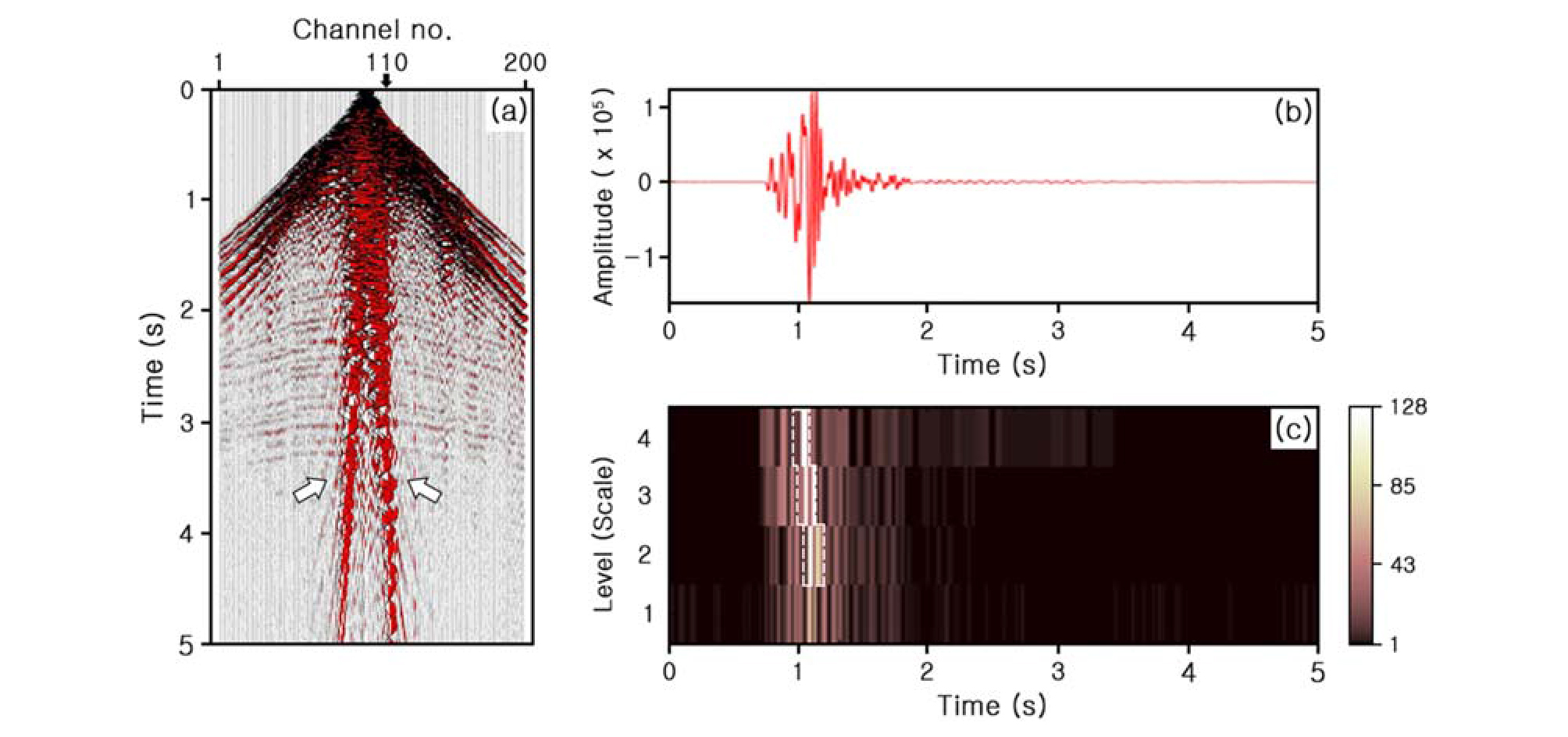
Fig. 6.
(a) Field shot record is contaminated by groundroll over the entire time (white arrows), degrading the continuities of reflection events. (b) Groundroll appearing at approximately 1000 ms for the trace 110 corresponds to (c) the white dotted area at the scales 2~4 on time-scale decomposition. Rightward movement of the peak amplitude with scale down explains the groundroll dispersion.
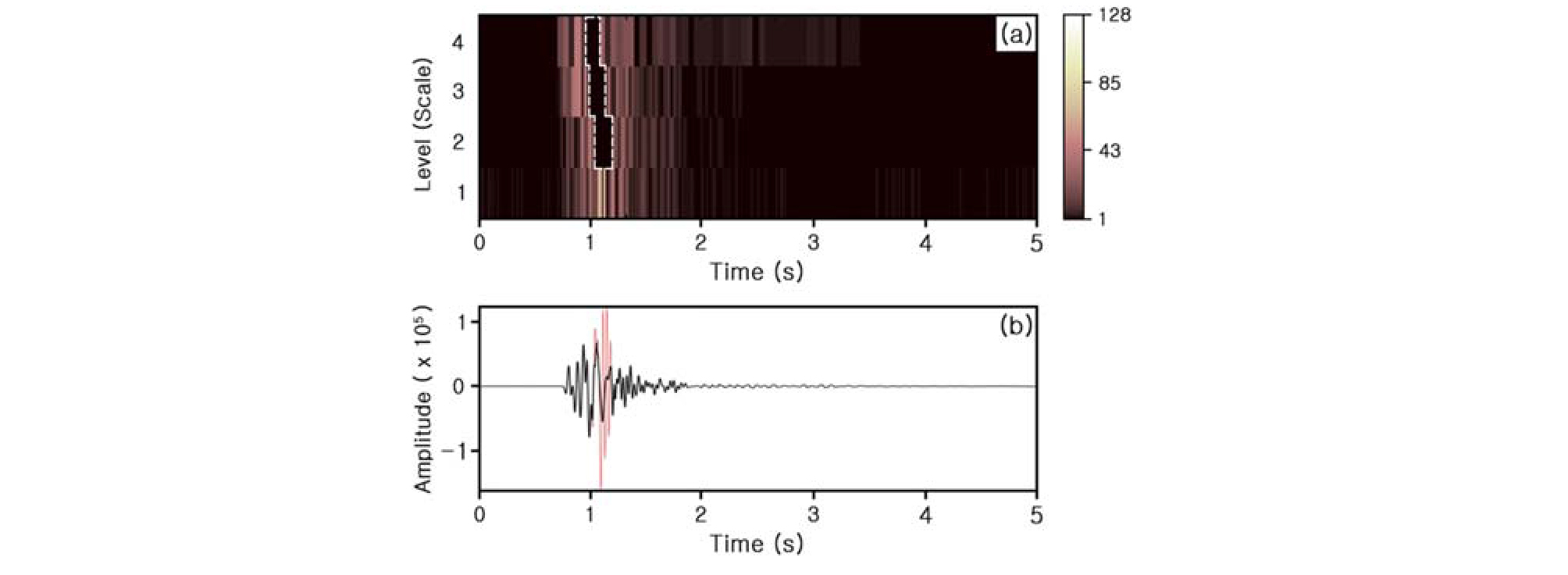
Wavelet decomposition (time-scale plot) of the trace 110 (Fig. 6b) is represented in Fig. 6c. It can be seen from this wavelet decomposition that peak energy is broadly concentrated in the scales of 2~4 at approximately 1000 ms. Rightward movement of the peak amplitude with scale down explains the wave dispersion for the groundroll in that the frequency content of the wave disperses with travel time (Fig. 6c). This characteristic is helpful to discriminate the groundroll from the reflection on the wavelet decomposition by zeroing the coefficients for peak-amplitude cells (Fig. 7a). After wavelet filtering on the basis of edited time-scale plot (Fig. 7a), the groundroll was successfully suppressed (Fig. 7b). Input trace (Fig. 6b) is superimposed on the output trace for the comparison.
Conclusions
The wavelet-transform (WT) filtering on the basis of the time-scale representation suppressed groundroll effectively in both the land-based synthetic and field seismic datasets, faithfully preserving frequency content of reflection signals. Dispersive groundroll is well explained in the WT decomposition, showing the time shifting of the peak-amplitude with scale changing.
The effect of WT filtering on the prestack gather is shown with the best image of the reflection, and the comparisons are made with standard FT (frequencytransform) filtering techniques. Bandpass filter suppressed the groundroll effectively but it also removed the corresponding frequencies from reflectors outside areas affected by the groundroll. F-k filter produces the better focused reflections but it can’t control the random noises (i.e., ringing) and artifacts due to spatial aliasing. These problems were overcome by meticulously editing the timescale data in that the time-scale properties of the WT allow filtering of specific time-frequency zones affected by groundroll, leaving the remainder of the trace unaltered.